A practical look at sustainability, human rights, and corporate responsibility in the Philippine economy — and why ESG and HRDD now shape the future of Philippine businesses.
Quick Context — ESG and HRDD in the Philippines
Environmental, Social, and Governance (ESG): A global framework that evaluates how responsibly an organization operates — covering climate impact, labor practices, community relations, ethics, and board governance. In the Philippines, ESG is now tied to investor expectations, SEC sustainability reporting, and climate-risk disclosures.
Human Rights Due Diligence (HRDD): A process under the UN Guiding Principles on Business and Human Rights requiring companies to identify, prevent, mitigate, and report how their operations and supply chains impact people’s rights. HRDD is increasingly required by global buyers, ESG investors, and emerging ASEAN policy trends.
Why this matters: Philippine companies are now expected to align ESG reporting with HRDD practices, especially in supply chains, labor conditions, climate vulnerability, and responsible business conduct. This article explores how these forces reshape the Philippine business landscape.
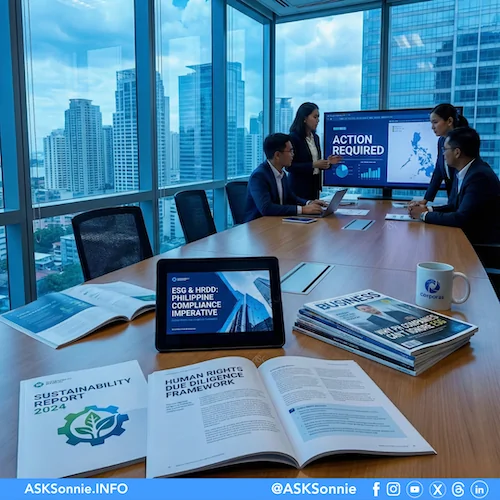
Introduction: A Tale of Two Philippines
At 9:45 PM in Bonifacio Global City, a 23-year-old BPO employee clocked in for her night shift. Two kilometers away, a corporate boardroom was wrapping up its quarterly report, highlighting improved sustainability scores and a new climate-risk initiative.
On one side of Manila are young Filipino workers battling fatigue, workplace stress, and precarious employment. On the other side are companies improving their ESG ratings and publishing sustainability reports to satisfy global investors and regulators.
What ties both worlds together is a concept still unfamiliar to many Philippine executives and employees: Human Rights Due Diligence (HRDD).
While ESG has become a buzzword in corporate Manila, HRDD is the backbone of the “S” and “G” — the deeper, more uncomfortable layer that deals with worker rights, supply-chain practices, and how businesses affect people’s lives.
Today, both ESG and HRDD are reshaping how Philippine companies must operate. And the shift is not optional anymore.
What Exactly Are ESG and HRDD?
ESG: The Corporate Report Card
Environmental, Social, and Governance (ESG) is a framework used by investors, banks, and regulators to see how responsibly a company operates — not just how big its profits are. A basic overview of ESG investing is provided by investor education resources such as the U.S. Securities and Exchange Commission’s Investor.gov portal.
Environmental, Social and Governance (ESG) Investing – Investor.gov
- E – climate impact, waste, emissions
- S – labor practices, community relations, consumer safety
- G – ethics, transparency, board oversight
Good ESG performance attracts capital, lowers risk, and boosts reputation. But ESG often stays at the reporting level — glossy sustainability PDFs and scorecards.
HRDD: The Hard Part Behind the Scenes
Human Rights Due Diligence (HRDD) comes from the UN Guiding Principles on Business and Human Rights (UNGPs). It is the ongoing process where a company checks how its activities and supply chain affect people’s rights, fixes problems, and reports what it is doing about them.
Guiding Principles on Business and Human Rights – OHCHR
Guiding Principles on Business and Human Rights – UNDP Asia-Pacific
- Find risks to people (not just risks to the company)
- Prevent, reduce, and repair harm
- Map suppliers and contractors, not just direct employees
- Listen to workers and communities through feedback channels
- Monitor and disclose human rights impacts
HRDD reveals the gaps ESG can gloss over — undeclared subcontracting, forced overtime, unsafe workplaces, low wages, and labor violations buried in supply chains.
ESG tells you what the company says. HRDD reveals what the company does.
Why Philippine Companies Must Integrate ESG + HRDD Now
1. Investors Are Watching the Philippines Closely
The Philippine Securities and Exchange Commission (SEC) now requires publicly listed companies to submit sustainability reports together with their annual reports under SEC Memorandum Circular No. 4, series of 2019. Legal and market commentaries on ESG investing in the Philippines note that investors and lenders increasingly look at ESG performance and disclosures when valuing companies in emerging markets.
ESG investing and sustainability reporting in the Philippines – The Legal 500
KPMG Philippines further observes that embedding ESG into corporate and legal functions helps companies minimize exposure to legal, financial, and reputational damages, especially as global standards for responsible business conduct tighten.
Embedding ESG into the legal function of the future – KPMG Philippines
2. Supply Chains Are Becoming Unforgiving
Global brands like Nestlé and Unilever now expect suppliers to meet human-rights and responsible-sourcing requirements, including having HRDD processes in place across their operations and supply chains. Their public human rights action plans and responsible sourcing policies spell out expectations on issues such as forced labor, child labor, safe working conditions, and living wages.
Salient human rights issues and action plans – Nestlé
Responsible sourcing – Nestlé
Living wage: key lessons from a decade of progress – Unilever
For Philippine manufacturers, logistics providers, and agricultural producers, weak HRDD capacity now means a higher risk of losing contracts or being excluded from preferred supplier programs as global buyers align with responsible business conduct guidelines.
3. Philippine Consumers Are Becoming More Conscious
Gen Z and millennial consumers worldwide tend to reward brands they perceive as ethical and environmentally responsible, and similar expectations are emerging among urban Filipino consumers. ESG and HRDD practices increasingly influence brand trust, employer attractiveness, and purchase decisions, especially in sectors like retail, banking, and digital services.
UN Guiding Principles overview – Business & Human Rights Resource Centre
4. ASEAN Is Shifting Toward Mandatory HRDD
Across Asia-Pacific, human rights due diligence is gradually shifting from voluntary CSR commitments to clearer regulatory expectations. Regional analyses of HRDD trends describe a “path from voluntary to mandatory,” as more jurisdictions explore or adopt laws that require companies to identify, prevent, mitigate, and account for human rights impacts in their operations and value chains.
Human Rights Due Diligence in the Asia Pacific Region: The path from voluntary to mandatory – Ethixbase360
Mandatory human rights due diligence – GlobalNAPS
Companies operating in or supplying to Asia-Pacific markets need HRDD systems that can respond to multiple, evolving due diligence rules, rather than treating human rights as a purely philanthropic or communications topic.
5. The Philippines Is One of the World’s Most Climate-Vulnerable Countries
The Philippines ranks among the more climate-vulnerable and less climate-ready countries in the Notre Dame Global Adaptation Initiative (ND-GAIN) Country Index, with high exposure to typhoons, flooding, and sea-level rise. This combination of high vulnerability and low readiness signals an urgent need for investment and innovation in adaptation and resilience.
Philippines country profile – ND-GAIN Index
For businesses, ESG is therefore a survival strategy that goes beyond traditional CSR. It is about climate-proof facilities, reliable infrastructure, workforce protection, and continuity planning. Responsible Business Conduct (RBC) and HRDD link these environmental risks to social and labor issues: how climate shocks affect workers, communities, and supply chains, and how companies share both risks and benefits as they adapt.
Responsible business conduct – OECD Guidelines for Multinational Enterprises
Case Studies: ESG in the Philippines
Case 1: SM Investments Corporation — ESG as Competitive Advantage
SM Investments Corporation (SMIC) has earned multiple recognitions for ESG and sustainability reporting, including a Platinum Award for Asia’s Best Materiality Reporting at the Asia Sustainability Reporting Awards. Its disclosures highlight how SM integrates climate resilience, disaster preparedness, and stakeholder engagement into its core business.
- Platinum recognition for sustainability and materiality reporting in Asia
SM Investments bags Platinum Award for sustainability reporting – Manila Bulletin - ESG Risk Rating of 13.3 (low risk) from Morningstar Sustainalytics, placing SM among top-rated sustainability companies in its industry and region
SM recognized as top-rated sustainability company – SM Investments
SM embeds ESG into climate-resilient malls, mixed-use estates, and disaster-ready communities, aligning its growth with the expected rise in Philippine urbanization over the coming decades. In its integrated reports, SM frames sustainability as part of long-term value creation for customers, tenants, investors, and host communities, not just a side project.
Our approach to sustainability – SM Investments Integrated Report
Case 2: AboitizPower — ESG as Energy Transition Strategy
AboitizPower integrates ESG into its operational and investment decisions, using sustainability metrics to guide its transition toward a more renewable and reliable power portfolio. Its ESG and sustainability webpages, along with its integrated report, disclose performance indicators on safety, emissions, resource use, and community investments.
- Publication of detailed ESG and sustainability disclosures covering environmental performance, social impact, and governance practices
ESG & Sustainability – AboitizPower - Recognition in governance and social impact awards that highlight strong corporate governance and community relations in the power sector
AboitizPower bags 2025 impact awards – AboitizPower
In a climate-exposed archipelago, AboitizPower shows how ESG can be a lens for grid resilience, renewable expansion, and community trust. Its approach illustrates how responsible business conduct in energy directly affects both environmental outcomes and the rights and wellbeing of workers and host communities.
Case 3: Ayala Corporation — ESG at the Urban Scale
Ayala Corporation’s sustainability programs span climate-adaptive infrastructure, low-carbon transport, water stewardship, and inclusive urban design in estates and developments across the country. Through its real estate, utilities, and infrastructure businesses, Ayala connects ESG targets with concrete changes in how Philippine cities grow and function.
Integrated Report 2023 – Ayala Corporation
Ayala’s experience shows that in the Philippines, real estate strategy is climate strategy — decisions on where and how to build shape exposure to floods, heat, and congestion, and influence whether workers and residents can live and move safely and affordably.
Integrated Report 2024 – Ayala Corporation
Case 4: Bank of the Philippine Islands (BPI) — Financing ESG
BPI promotes ESG adoption by integrating sustainability into its lending and investment decisions. Its published sustainability and climate-related disclosures describe policies on environmental and social risk assessment, climate risk stress testing, and green finance instruments.
IFC partners with BPI to increase climate finance – BPI
Climate Risk Disclosures of BPI International Finance Limited – BPI
- Implementation of sustainable lending and environmental and social risk management criteria for sectors with environmental and social risks
- Climate-risk stress testing for loan and investment portfolios
- Financing of renewable energy, energy efficiency, and eco-friendly projects, including green bonds and dedicated green lending programs
When banks start to ask borrowers for ESG information and stronger risk management, companies adjust their practices. Finance becomes a powerful driver for embedding ESG and responsible business conduct into everyday business decisions.
BPI deepens sustainability commitment via green finance milestones and perks – InsiderPH
Case Studies: HRDD in the Philippine Context
Case 5: Nestlé — Global HRDD, Local Impact
Nestlé operates one of the more developed corporate HRDD frameworks, with public documentation on salient human rights issues and action plans. These materials set out how the company identifies, prevents, and mitigates risks related to forced labor, child labor, working conditions, and other human rights concerns.
- Publication of human rights action plans and salient issues, including specific measures and timelines
Salient human rights issues and action plans – Nestlé - Dedicated pages on forced labor and child labor interventions in supply chains
Forced labour and responsible recruitment – Nestlé - Responsible sourcing program that sets human rights and environmental expectations for suppliers
Responsible sourcing – Nestlé
For Philippine suppliers, these HRDD and responsible sourcing expectations mean that weak human rights management can lead to heightened scrutiny, corrective action plans, or loss of business. Aligning with such frameworks is increasingly part of staying competitive in global value chains.
Case 6: Unilever Philippines — HRDD Meets Living Wage
Unilever embeds HRDD into its global operations by focusing on salient issues such as fair wage and income, working hours, and safe working conditions. It has publicly committed to ensuring that everyone who directly provides services to the company earns at least a living wage, and it is extending this expectation to suppliers through its Responsible Partner Policy.
- Implementation of human rights due diligence programs and worker voice mechanisms across operations and value chains
- Supplier maturity assessments that evaluate human rights and labor practices
- A Living Wage Supplier Programme and Living Wage Promise aimed at ensuring that workers in the value chain earn at least a living wage by 2030
Living wage: key lessons from a decade of progress – Unilever
In this model, HRDD is not just about preventing harm; it is about promoting decent work and fair income. The combination of HRDD and living wage commitments shows how responsible business conduct can move from compliance to positive impact on workers’ lives.
Case 7: DOLE & the Philippine Labor Rights Landscape
The Department of Labor and Employment (DOLE) plays a major role in shaping how HRDD obligations play out in practice through labor standards enforcement, social dialogue, and policy research. DOLE’s Institute for Labor Studies (ILS) publishes working papers that link decent work, climate transition, green jobs, and just transition strategies in the Philippine context.
Labor-rights groups have flagged BPO sector concerns involving safety, overtime, and contract terms, and have called on industry associations to balance investor demands with workers’ rights. DOLE and its research arm increasingly highlight that just transition and decent work must be part of the country’s climate and development agenda, which aligns with the responsible business conduct approach promoted by international organizations.
2024 working papers – DOLE Institute for Labor Studies
BPO firms assoc told: balance profits with labor rights – CTUHR
Case 8: The Philippine BPO Sector — HRDD in Real Life
The BPO industry now supports more than 1.5 million jobs and contributes a significant share of Philippine GDP, underscoring its central role in the economy and in the lives of many young workers. Industry analyses and labour rights reports point to recurring issues such as occupational safety gaps, forced or excessive overtime, psychological hazards, and wage and contract disputes.
With global clients increasingly asking about how outsourced workers are treated, the Philippines must elevate HRDD practices in BPO workplaces to remain a trusted outsourcing destination. Responsible business conduct in this sector means not only delivering service-level agreements, but also protecting workers’ health, rights, and voice.
Current state of outsourcing in the Philippines – Satoden
BPO firms assoc told: balance profits with labor rights – CTUHR
The Big Picture: ESG + HRDD Are Merging
The divide between boardroom ESG and street-level HRDD is closing fast. Investors increasingly ask for credible ESG data, regulators tighten sustainability reporting, and global buyers adopt responsible sourcing standards that include human rights due diligence.
- Investors demand ESG disclosures and credible sustainability metrics to assess long-term risk and value.
- Global buyers require HRDD and responsible business conduct in their supply chains, not just price and volume.
- Workers push for fair treatment, safe workplaces, and meaningful avenues for raising concerns.
- Regulators develop sustainability and labor rules that increase transparency and accountability.
- Consumers, especially younger generations, increasingly expect ethical and climate-conscious brands.
This is the new Philippine business landscape.
When Companies Get ESG but Ignore HRDD
Companies that focus on ESG reporting but neglect HRDD often end up with:
- Good ESG ratings but recurring labor controversies
- Sustainability reports but worker walkouts
- Compliance certificates but supply-chain violations
- Climate initiatives but unethical contractor practices
Real sustainability requires both: ESG for transparency, HRDD and responsible business conduct for accountability.
Conclusion: The Philippines Is Entering Its ESG-HRDD Era
Climate vulnerability, global supply-chain pressure, ASEAN policy shifts, investor expectations, and domestic labor realities all point in one direction. Philippine companies need to embed ESG and HRDD not just as CSR projects, but as core strategy and day-to-day practice.
Those who adapt will thrive and earn the trust of investors, workers, regulators, and consumers. Those who do not will increasingly be left behind — in capital markets, in global supply chains, and in the eyes of the people they employ and serve.
This article draws from SEC sustainability reporting rules, DOLE-ILS working papers, the UN Guiding Principles on Business and Human Rights, and public ESG/HRDD disclosures of the companies mentioned.
ASK Takeaway — Applying ESG + HRDD Through the ASK Framework:
- Align company values, governance, and supply-chain expectations with global ESG and HRDD standards.
- Strengthen systems for transparency, worker voice, compliance, and climate resilience.
- Kickstart a culture of responsible business conduct through leadership modeling, training, and stakeholder engagement.
Explore more leadership and corporate governance insights at:
ASK Framework: Align • Strengthen • Kickstart
Frequently Asked Questions
Is HRDD required by Philippine law?
Not yet as a standalone law, but HRDD expectations are embedded in global buyer requirements, SEC sustainability reporting, DOLE labor standards, and emerging ASEAN policy trends.
How is ESG different from CSR?
CSR is often philanthropic and optional. ESG is data-driven, investment-relevant, and subject to regulatory and market scrutiny.
Can SMEs in the Philippines implement ESG + HRDD?
Yes. SMEs can start small by mapping risks, engaging workers, improving supplier transparency, and integrating ESG into basic policies and processes.
Will ESG and HRDD affect the ability to get clients or investors?
Absolutely. Many investors, banks, and global buyers now require ESG disclosures and HRDD compliance as part of procurement or financing criteria.