For more than a decade, I trusted Apple not just for its products, but for the promise behind them. This is a first-hand account of how that promise was tested through an Apple Care warranty experience in the Philippines—and what it revealed about systems, service, and trust.
@asksonnie My Apple Care Warranty Experience The bad, the good and the case resolution @beyondtheboxph #Apple #macbookrepair #applecare #vstecsphils #customerexperience ♬ Inspiritional Inspiring Drama – KarmaMusicUa
My Apple Care Warranty Experience
For more than a decade, I have been an Apple customer.
My first MacBook Pro was the iconic white one. My second MacBook lasted 11 years before I replaced it. My iPad 2 still works, as does my iPhone 5.
READ: Krispy Kreme Replaced My MacBook Pro
Today, I use an iPhone 16 Pro Max, an iPad Pro with Apple Pencil, and a MacBook Pro M3 Pro.
I believe in Apple’s engineering. I believe in the durability of their products. And I believe in the value of Apple Care.
As a People Strategist with over 30 years in the industry, I often speak about organizational systems and the human side of governance. Recently, however, I found myself on the other side of the desk—not as an advisor, but as a frustrated customer navigating a corporate service structure that almost cost me ₱50,000 and my loyalty to a brand I had supported for over a decade.
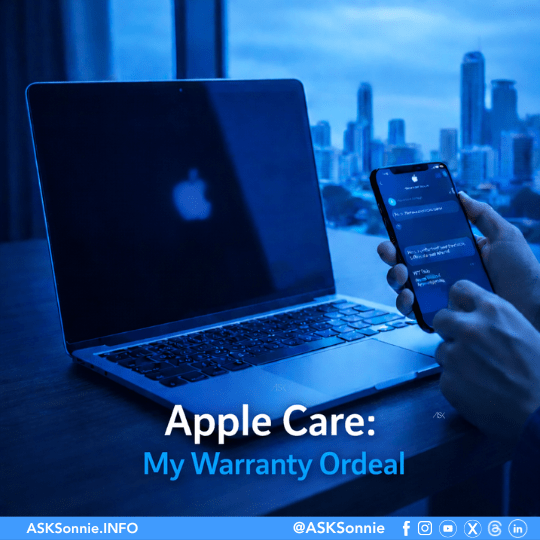
When My MacBook Pro M3 Screen Suddenly Died
About six months after purchasing Apple Care to extend the warranty of my MacBook Pro M3 Pro, the internal display suddenly stopped working. No drops. No spills. I simply closed the lid during a break, and when I returned:
- Black screen
- The device powered on
- I heard the boot sound
- A blurry Apple logo appeared—then nothing
When connected to an external monitor, the display extended, but the login panel was hidden.
The machine was technically alive—but practically unusable.
Beyond the Box: A Frustrating First Apple Care Touchpoint
I first went to Beyond the Box at Robinsons Ermita. While the staff were warm and accommodating, they referred me to their BGC branch since the Ermita location does not handle repairs.
The following day, I arrived early. There were no other customers. Yet the experience was disappointing.
They wanted me to:
- Hand over the unit without inspecting it in my presence
- Wait 3–5 days for feedback
- Back up my files—even though I could not log in
They did not offer to help me access the system via an external display. There was no diagnostics, no guided support—just cold process and handoff.
VST ECS: A Promising Referral
Through a referral from an acquaintance, I went to VST ECS in BGC, an Apple-authorized service provider.
A Better Apple Care Warranty Experience
Initially, the experience was professional and reassuring. They:
- Helped me log in using an external monitor
- Assisted with backups
- Asked me to log out of iCloud
- Guided me through erasing the device properly
- Inspected the unit and found no obvious warranty violations
Then the Emotional Roller Coaster Ride
Without requesting my consent or inviting me to witness the process, technicians removed my screen protector and claimed to have found a tiny dot on the display—a microscopic flaw. This became the basis for Apple to deny the warranty claim.
The quoted repair cost was almost ₱50,000.
No appeal process was offered, despite my request, only a subtle conclusion.
Escalating to Apple Care Support
I reached out to Apple’s regional support handling Philippine cases.
I was initially endorsed to a Senior Advisor named Rick. He said that the treatment at Beyond the Box BGC was sub-standard, and the warranty procedure handling was not followed at VST ECS. He promised a positive resolution after the Christmas and New Year holidays.
Then Rick ghosted.
- No replies
- No updates
- No handover
The “Emotional Outsourcing” Problem
After repeated email and voice messages for Rick, I made another call. I was endorsed to another advisor named Mari who took over my case. She was empathetic but honest.
Mari facilitated a three-way call with the service provider to find a resolution. However, the discourse became nasty because the narrative being painted “seemed” to:
- Justify the warranty denial
- Support a pre-decided conclusion
Here lies the structural truth I learned the hard way.
As a strategist, I realized the setup was designed for emotional outsourcing—hiring kind people to listen to complaints they have no operational power to fix.
Apple advisors can listen, document, and mediate—but they cannot initiate appeals or reverse warranty decisions. The authority to appeal remains with the local service provider.
Meaning: the same provider that discovered the “dot” also controlled the appeal.
The Systemic Issues of Apple Care Warranty Claims
1. Siloed Accountability
Apple customer service support hotline listens. But listening without authority is not service—it is emotional outsourcing.
2. Overpromising Advisors
Rick created false hope and caused a huge reputational damage to Apple.
3. Appeals Without Representation
Service providers control both diagnosis and appeal—a structural conflict of interest.
The Unexpected Ending
Through Mari’s intervention, VST ECS initiated an appeal. And while I no longer expected a positive outcome and ready to escalate my case to DTI, Apple listened—and reversed its initial decision.
Within three days:
- The entire display assembly was replaced
- The repair was fully covered
The system worked—but only after weeks of escalation and emotional cost.
What This Apple Care Warranty Experience Taught Me
Apple builds world-class products. But a “world class” customer experience is only as good as the process and the people representing the brand.
A Fair Conclusion
The bad truth: the Apple Care warranty process is opaque and structurally conflicting.
The good truth: Apple still has people like Mari—and service providers like VST ECS—who despite being in a difficult situation with me, ultimately helped reverse the outcome.
Call to Action
Guidance for Apple Care Claimants in the Philippines
- Clarify the process early and align your expectations accordingly.
- Document every step—especially take clear photos and videos before turning over your unit.
- Secure explicit consent for any action that may later lead to dispute. For example, removing my screen protector without my consent led to the discovery of a “dot” that became the basis for voiding the warranty.
- As an Apple customer, expect no less than the premium experience the brand promises.
For Apple as a “Premium” Brand
Revisit your warranty appeal governance and ensure premium experience is delivered at every customer touchpoint
For the Apple Community
Share your experiences. Patterns enable customers to insist on premium service.
Final Reflection
Good endings deserve credit. But they do not erase organization culture and systems that quietly degrade trust.
I remain an Apple customer because my intellectual property and professional outputs are embedded in their ecosystem.
But this experience reminded me of a hard truth: Brand promise is global. Customer experience is local. And oftentimes, the gap between the two is where trust quietly breaks.
💡 The ASK Takeaway
This experience reflects why the ASK Framework—Align • Strengthen • Kickstart—matters beyond leadership theory:
- Align: Systems must align authority with accountability.
- Strengthen: Processes should empower frontline advisors, not limit them.
- Kickstart: Feedback loops must trigger real corrective action.
Frequently Asked Questions
Can Apple Care be denied due to minor cosmetic issues?
Yes. Local service providers may deny warranty claims based on physical findings they classify as damage—even if microscopic.
Can Apple Support override local service provider decisions?
No. Apple advisors can mediate and document, but appeal authority rests with the local service provider.
Is there an appeal process for denied Apple Care claims?
Yes, but it must be initiated by the service provider itself, which creates a potential conflict of interest.
What should customers do to protect themselves?
Document everything, request transparency, and insist that inspections be done in your presence.
About the ASK Framework
This article reflects the core philosophy behind the ASK Framework—Align • Strengthen • Kickstart—a leadership and governance model developed to help individuals and organizations build systems that work with people, not against them.
- Align values, authority, and accountability so trust is built into the system.
- Strengthen people and processes to prevent avoidable breakdowns.
- Kickstart action through feedback, learning, and continuous improvement.
🔗 Learn more about the ASK Framework here:
Align • Strengthen • Kickstart