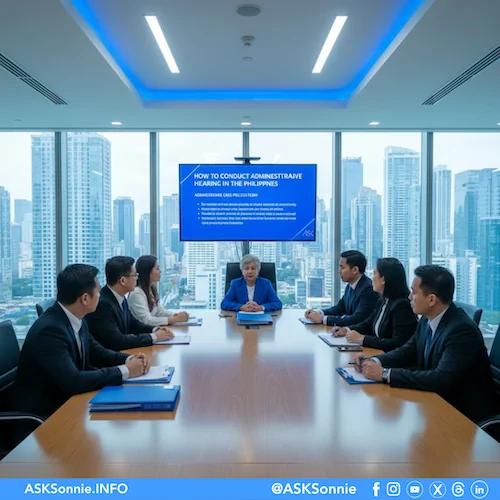
An administrative hearing or administrative meeting, is not a courtroom drama nor a punishment — it is a structured due process step that allows all sides to be heard before a decision is made. This guide explains how to conduct an administrative hearing in the Philippines fairly, legally, and professionally.
How to Conduct an Administrative Hearing or Administrative Meeting in the Philippines
Practical Legal Context (Philippines)
An administrative hearing — sometimes called an administrative meeting — is part of procedural due process in the workplace under Philippine labor law. Its goal is fact-finding and fairness, not punishment. Under the Labor Code and DOLE rules, employers must observe twin written notices and give the employee an ample opportunity to be heard before termination or serious disciplinary action is imposed. Articles 292, 297–298, Labor Code
In practice, an administrative hearing happens after the company issues a Notice to Explain (NTE) and before releasing the final Notice of Decision, with or without preventive suspension.
This guide reflects common HR and labor-relations practices observed in Philippine organizations, as of 2026, across multiple industries.
What is an Administrative Hearing or Administrative Meeting?
An administrative hearing— sometimes called an administrative meeting, is a structured meeting where the incident is reviewed, evidence is presented, and the employee under investigation can fully explain their side, ask questions, and submit their own evidence. It is one way of giving the employee an “ample opportunity to be heard,” which the Supreme Court recognizes as the core of procedural due process in termination cases. G.R. No. 247428 (2021)
Philippine jurisprudence clarifies that a trial-type hearing is not always mandatory, but the opportunity to explain must be real, meaningful, and documented — not just a formality. Autobus Workers’ Union v. NLRC, G.R. No. 117453 (1998)
Who handles the administrative hearing?
In some companies, a standing investigating or grievance committee handles the administrative hearing, with clearly defined roles (chair, HR, management representative, recorder, etc.). In many organizations, the Human Resource head or Labor Relations head manages the entire administrative investigation, from the NTE up to the recommendation for a Notice of Decision.
When is an administrative hearing needed?
An administrative meeting
- Clarify disputed facts or inconsistencies in written statements
- Assess the credibility of the employee, complainant, and witnesses
- Ensure the employee is genuinely heard and not just “asked to sign” documents
- Arrive at a fair and well-documented recommendation for management
In some cases, the Supreme Court has accepted written explanations alone as sufficient “ample opportunity to be heard,” but a properly documented administrative hearing remains a best practice to manage risk and show good faith. Discussion on ample opportunity to be heard
Before the administrative meeting
- Confirm a suitable venue. The room should be enclosed, secure, well-lit, ventilated, and free from distractions. If possible, provide chairs outside where other participants can wait separately.
- Prepare basic logistics. Ensure tables, chairs, drinking water, and writing materials are already in place before the hearing starts.
- Arrange recording and documentation. Prepare an audio recorder (a mobile phone is acceptable) and assign a person or team to take formal minutes of the proceedings.
- Organize all evidence. Gather documentary, audio, or video evidence and test any equipment needed to present them properly.
- Prepare a clear hearing flow. While there can be flexibility, a typical order is:
- Incident report author
- Witnesses
- Complainant (if any)
- Immediate superior of the employee under investigation
- Employee under investigation (one at a time if there is more than one)
During the administrative hearing
- Brief the committee or panel. If a permanent investigating committee does not exist, briefly clarify the role of each member to avoid grandstanding, bias, or overlapping functions.
- Set clear ground rules.
- Inform all present that the proceedings will be recorded, and secure and note their consent.
- Require participants to state their name and role before speaking.
- Maintain orderly discussion — one speaker at a time, with the chair controlling who has the floor.
- Present the allegations clearly.
- Read and explain the incident report or complaint.
- Identify the specific company rules, codes of conduct, or policies allegedly violated.
- Explain the impact of the incident on people, safety, property, operations, or company image.
- Present evidence. Lay out documentary and testimonial evidence transparently, and allow reasonable questions from the employee and panel.
- Allow the employee to respond fully.
- Give the employee sufficient time to answer the allegations and clarify any points.
- Allow the employee to be assisted by a representative of their choice, consistent with company policy and any applicable CBA.
- Allow the employee to present counter-evidence, documents, or witnesses.
- Open the floor for clarifications. Let the panel or committee ask reasonable questions to clarify facts and test consistency.
- Confirm completeness. Before closing, let the minute-taker recap key points to confirm that no material issue has been missed.
- Close with next steps. Inform all parties if another hearing is needed and explain the expected timeline for evaluation and release of the Notice of Decision.
After the administrative hearing
Within a reasonable period (commonly about one week, depending on company policy and case complexity), the investigating body should:
- Evaluate the evidence and testimonies objectively, applying the “substantial evidence” standard used in administrative cases.
- Prepare a written case report with findings of fact, rule violations (if any), and recommended action for management review.
- Coordinate the issuance of the Notice of Decision to formally conclude the case, whether it results in exoneration, a lesser penalty, or termination.
Frequently Asked Questions on Administrative Hearings (Philippines)
Frequently Asked Questions
Is an administrative hearing required in all termination cases?
No. Philippine jurisprudence does not require a formal, trial-type hearing in all cases. What the law requires is that the employee is given an ample opportunity to be heard, which may be satisfied through written explanations, conferences, or an administrative hearing, as long as the opportunity is real, meaningful, and properly documented.
Can an employee refuse to attend an administrative hearing?
Employees are encouraged to attend so they can explain their side and present evidence. If, despite proper notice, the employee deliberately refuses to appear or repeatedly postpones without valid reason, the employer may proceed based on available evidence, provided the records clearly show that opportunities to be heard were given.
Are lawyers allowed during an administrative hearing?
This depends on company policy, any existing collective bargaining agreement, and the nature of the case. Many employers allow a representative of the employee’s choice, who may or may not be a lawyer, as long as the process remains non-intimidating and focused on fact-finding rather than adversarial litigation.
How soon should the Notice of Decision be issued after the hearing?
The law does not fix a specific timeline. However, the Notice of Decision should be released within a reasonable period after the hearing, taking into account the complexity of the case. Many organizations aim to complete evaluation and issue the decision within about one week, unless further inquiry is needed.
What if new issues or evidence arise during the administrative hearing?
If substantial new issues or evidence are raised, the investigating body may schedule a follow-up hearing or allow additional time for verification. What matters is that the new matters are documented and genuinely considered before management issues the final decision.
💡 The ASK Takeaway
A well-handled administrative hearing is not just a legal requirement — it is a culture signal. It shows employees that accountability, fairness, and respect for due process are non-negotiable in your organization.
- Align your disciplinary process with both the Labor Code and your company values — from NTE, to hearing, to Notice of Decision.
- Strengthen your leaders’ capability to conduct hearings that are calm, documented, and free from bias or grandstanding.
- Kickstart a people-first culture where employees trust that investigations are handled fairly, even when outcomes are uncomfortable.
To see how this fits into the bigger picture of values-aligned HR and leadership, check out our overview of the
ASK Framework — Align • Strengthen • Kickstart.
This article is for general information only and does not constitute legal advice. Labor laws, DOLE issuances, and Supreme Court jurisprudence are updated from time to time. For case-specific guidance, always consult qualified legal counsel or your company’s legal department.

 wpDiscuz