Progressive discipline, when done properly, helps employers correct behavior fairly and lawfully before considering termination, while giving employees a real chance to improve.
2026 Updated Guidance on Progressive Discipline (Philippines)
This article refreshes earlier discussions on progressive discipline and employee termination in light of the renumbered Labor Code (Article 297, formerly 282) and recent jurisprudence. It is written from a practitioner’s perspective for HR leaders, line managers, and employees in the Philippines who need a practical, plain-language guide.
Evergreen note: While laws and cases may evolve, the core principles of just cause, due process, documentation, and fair treatment remain central. Check DOLE issuances and Supreme Court decisions for the latest updates.
Introduction: Why Progressive Discipline in the Workplace Matters
What this article covers
This guide is for both employers and employees who want to understand how discipline and termination work in real-life workplace situations in the Philippines, using simple and practical language. It explains what progressive discipline in the workplace is, how it connects to Article 297 of the Labor Code, what kinds of repetitive acts may lead to termination, and why due process and documentation are non-negotiable.
How progressive discipline in the workplace protects both sides
In most cases, employees are not terminated because of a single, minor mistake. Dismissal usually comes after repeated or serious violations that have been documented and addressed through a structured process often called progressive discipline.
When applied correctly, progressive discipline protects the company by showing that it acted fairly and consistently, and it protects the employee by providing clear feedback, fair warnings, and a genuine opportunity to improve before termination is considered.
What Is Progressive Discipline in the Workplace?
Definition and purpose
Progressive discipline in the workplace is an approach to employee discipline where corrective actions increase in seriousness depending on the nature and repetition of the violation. The main goal is corrective, not punitive: to change behavior and align employees with company values and policies, instead of simply “getting rid” of people. It provides a clear path from coaching to stronger measures when needed, anchored on just causes and due process under Philippine labor law.
Common stages of progressive discipline in the workplace
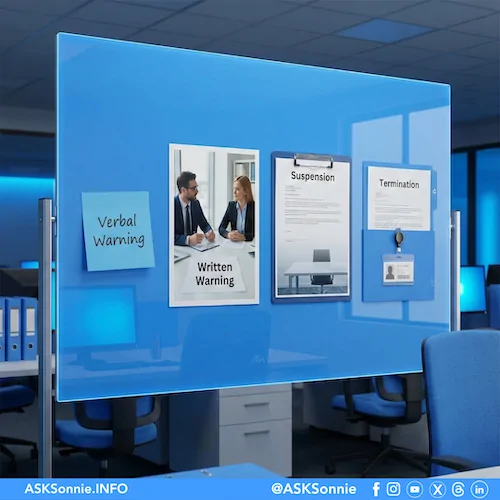
In practice, progressive discipline often moves through stages such as coaching or verbal reminders, written warnings, final warnings or suspension, and, when necessary, termination of employment. The exact steps, wording, and timelines depend on the company’s code of conduct, the seriousness of the offense, and the employee’s overall track record.
When immediate termination may be justified
While progressive discipline usually involves several stages, very serious violations that affect life, safety, security, or trust may justify immediate termination even without going through each step, as long as there is a valid just cause and proper due process has been observed. For example, acts that qualify as serious misconduct under Philippine labor law may warrant dismissal after a proper investigation and compliance with procedural requirements.
Legal Update on Article Numbering
From Article 282 to Article 297
What used to be Article 282 of the Labor Code is now renumbered as Article 297 (Termination by Employer) under the official renumbered Labor Code issued by the Department of Labor and Employment (DOLE). The substantive rules remain, but the current reference point in legal documents and decisions is DOLE Department Advisory No. 1, Series of 2015 on the Renumbered Labor Code.
Legal Bases Under Philippine Law
Article 297 and just causes for termination
In the Philippines, termination for “just causes” (lawful grounds that make dismissal valid) is governed by Article 297 of the Labor Code (formerly Article 282), as renumbered by the DOLE advisory cited above. Under Article 297, an employer may terminate an employee for serious misconduct or willful disobedience, gross and habitual neglect of duties, fraud or willful breach of trust, commission of a crime or offense against the employer or its representatives, and other causes analogous to these grounds.
Serious misconduct
“Serious misconduct” refers to a grave, wrongful act that is related to the employee’s work and shows that the employee is unfit to continue working, not just a minor or isolated mistake. Guidance on what may qualify as serious misconduct can be found in resources such as LaborLawPH’s discussion of serious misconduct and just causes, as well as decided cases of the Supreme Court.
Gross and habitual neglect
“Gross and habitual neglect” means repeated failure over time to perform basic duties, not just one or two slips. It involves a pattern of neglect that shows a disregard for obligations and company rules. Various Supreme Court rulings compile examples of conduct that have been considered gross and habitual neglect, as seen in collections of jurisprudence such as the Compilation of Jurisprudence on Gross and Habitual Neglect of Duty.
How progressive discipline connects to these grounds
Progressive discipline in the workplace is often applied in relation to serious misconduct, willful disobedience, and gross and habitual neglect. It helps show that the employer did not jump to termination at the first sign of trouble, but instead documented repeated violations, issued warnings or coaching, and gave the employee reasonable chances to correct their behavior before resorting to dismissal.
Role of the Company Handbook or Code of Conduct
Turning Article 297 into day-to-day rules
The company handbook, code of conduct, or code of discipline serves as the practical “playbook” for progressive discipline in the workplace. It translates the general grounds in Article 297 into concrete workplace rules by defining specific offenses, corresponding sanctions, and internal procedures. Many organizations use their handbook to spell out how progressive discipline will be applied, including examples and graduated penalties.
Habitual infractions and active periods
A well-designed discipline policy should define what makes an offense “habitual” (for example, how many times an employee can be late before it is treated as a pattern) and how long a past offense stays “active” for progressive discipline purposes. Practical guidance on designing these systems can be found in resources like Lawyer Philippines’ overview of disciplinary systems and habitual absenteeism.
When there is no handbook
In the absence of a clear company handbook or code of conduct, employers and employees will have to rely more directly on the Labor Code, DOLE issuances, and Supreme Court jurisprudence. Decisions of the Court, as published in the Supreme Court E-Library, provide guidance on how just causes and due process are interpreted and applied in actual cases.
Examples of Repetitive Acts That May Lead to Termination
Minor infractions may not look serious when viewed one at a time. However, when they become frequent, well-documented, and clearly brought to the employee’s attention, they may qualify as gross and habitual neglect or related just causes under Article 297, depending on the circumstances. This is why patterns of behavior matter as much as individual incidents.
Supreme Court decisions have acknowledged that repetitive acts such as chronic absenteeism, repeated insubordination, or persistent poor performance, when properly documented and processed, can justify dismissal. At the same time, the Court has emphasized that the law requires “serious” misconduct or “gross and habitual” neglect, and that truly minor or isolated infractions normally do not reach this threshold. One decision often cited in this context is Pacific Metals Corporation v. De Vera, G.R. No. 178246 (26 September 2017), which highlights both the importance of repeated violations and the need for proper procedure.
Why Documentation and Communication Matter
For employers
Progressive discipline is only as strong as the documentation and communication that support it. Employers are expected to record relevant infractions, coaching sessions, and warnings, and to keep copies of notices and written explanations. Well-kept records help show that the employee was made aware of the rules, that the company responded consistently, and that termination, if it happens, is based on evidence and not mere opinion.
For employees
For employees, understanding the code of conduct and acknowledging notices helps clarify their status and protect their rights. Each step of progressive discipline should give the employee a chance to submit explanations, evidence, or requests for reconsideration. Clear communication also helps employees see what specific behavior they need to correct and what support (such as coaching or retraining) is available.
Due Process Before Any Disciplinary Action
The twin-notice rule and the right to be heard
Before an employer can impose any major disciplinary action—especially termination—it must observe due process. In the Philippine context, this is often summarized as the “twin-notice rule” and the employee’s right to be heard. A practical overview of these requirements and their application in workplace investigations is discussed in my separate guide on due process in the workplace.
The process usually starts with a first written notice explaining the specific charges and giving the employee a chance to respond. After this, the employee must be given a meaningful opportunity to be heard—whether through a formal hearing, a conference, or a written explanation—before any final decision is made.
How jurisprudence reinforces procedural due process
Only after the employer has evaluated the evidence and the employee’s explanation should it issue the second written notice informing the employee of the decision and the reasons for it. In Pacific Metals Corporation v. De Vera, the Supreme Court discussed both the elements of serious misconduct and the strict need to follow procedural due process in termination cases. Other decisions on gross and habitual neglect echo the same principle: repeated violations may justify dismissal when they are well-documented and properly communicated, but shortcuts in procedure expose the employer to potential liability, even when there is otherwise a valid ground.
Disclaimer
Disclaimer: This article is for general information and educational purposes only and does not constitute legal advice. Specific cases may involve additional facts, documents, or applicable laws that are not covered here. For concrete situations, consult a lawyer or HR/legal professional familiar with Philippine labor law and current Supreme Court jurisprudence, which can be accessed through the Supreme Court E-Library.
💡 The ASK Takeaway
Progressive discipline and lawful termination decisions sit at the intersection of culture, compliance, and leadership. They are opportunities to live out the ASK Framework — Align • Strengthen • Kickstart:
- Align your discipline policies with your values, mission, and the requirements of Philippine labor law, so that rules are clear, consistent, and well-communicated.
- Strengthen your culture by documenting fairly, coaching intentionally, and giving employees a real chance to improve before you consider ending the employment relationship.
- Kickstart better performance and trust by using each case as a learning moment — reviewing gaps in onboarding, supervision, and systems that may have contributed to the issue.
Learn more about the ASK Framework and how it shapes HR and leadership decisions.
Frequently Asked Questions on Progressive Discipline
Is progressive discipline required before terminating an employee in the Philippines?
The Labor Code does not explicitly say that employers must always follow a step-by-step progressive discipline ladder before terminating employment. However, the law requires a valid just cause and observance of due process. Progressive discipline is widely recognized as a fair and practical way to show that the employer acted reasonably, especially for performance issues and repeated minor violations. It also helps employees see that they were given clear expectations and opportunities to improve.
Can a single serious offense justify termination without going through all stages of progressive discipline?
Yes. A single act may be serious enough to justify termination when it qualifies as a just cause, such as serious misconduct, willful disobedience, fraud, or a crime against the employer or its representatives. Even in those cases, however, the employer must still respect procedural due process by issuing the proper notices and giving the employee a chance to explain. Progressive discipline is not a shield for very serious violations, but it remains useful in borderline or repetitive cases.
How long do written warnings remain “active” for purposes of progressive discipline?
The Labor Code does not prescribe a fixed validity period for written warnings. The usual practice is for the company handbook or code of conduct to define how long a warning remains active, for example six months or one year. What matters is that the rule is clear, reasonable, communicated to employees, and applied consistently. Inconsistent use of old or forgotten warnings may weaken the employer’s position in a dispute.
What can employees do if they feel progressive discipline is being abused or unfairly applied?
Employees who believe that progressive discipline is being used unfairly can submit a written explanation, escalate concerns through the company’s grievance process, or seek advice from HR, a union, or a legal professional. Keeping copies of notices, explanations, and related communications is important. If the case escalates to a complaint, these documents help show whether the employer treated the employee consistently with the handbook, company policies, and Philippine labor law.

 wpDiscuz