January 28, 2026 Update: Online Shaming and Content Monetization
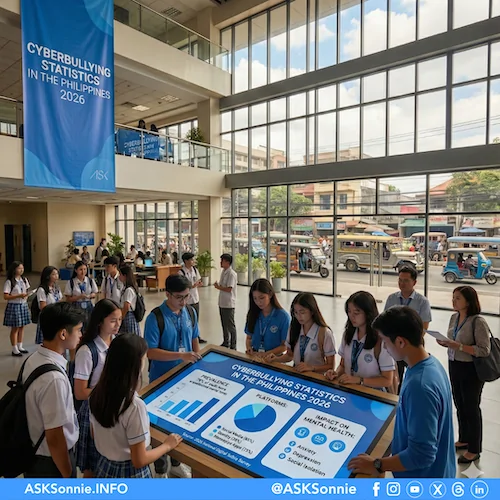
Cyberbullying statistics in the Philippines show that many Filipino children and young people continue to face online harassment despite existing laws and school policies. This article consolidates the most recent evidence to explain what the numbers reveal as the country moves into 2026.
Scope note: There is no single nationwide survey officially titled “Cyberbullying Statistics 2026.” The figures below synthesize data from PISA 2019 and 2022, SEA-PLM 2019, the National Baseline Study on Violence Against Children, DepEd and EDCOM 2 reports, and Philippine National Police Anti-Cybercrime Group (PNP-ACG) releases, as well as related analyses from PIDS and civil society studies.
Patterns of cyberviolence are equally concerning. The National Baseline Study on Violence Against Children, as summarized in the country report Towards Safer Schools for Children: The Philippines (2025), estimates that around 42.8% of students experience cyberviolence. A UNICEF-linked survey reported in Newsbytes notes that roughly one-third of Filipino children encounter online verbal abuse and about one-fourth receive messages or content of a sexual nature.
At the same time, the PNP Anti-Cybercrime Group reports year-on-year increases in cases such as online libel and photo/video voyeurism. According to GMA News and the Philippine Daily Inquirer, online libel cases rose from 1,403 in 2023 to 1,458 in 2024, while voyeurism complaints increased by about 18% in the same period — many involving non-consensual sharing of intimate content.
For parents, educators, HR practitioners, and policymakers, these numbers represent more than abstract data points. EDCOM 2 and PIDS warn that bullying and cyberviolence are eroding learning outcomes, mental health, and the country’s human capital. A more narrative and values-based discussion of how technology and AI shape online behavior can be found in the companion piece “Cyberbullying 2025: Hope Counters AI-Driven Aggression”.
Key points at a glance:
- International assessments place the Philippines among the countries with the highest reported rates of school bullying.
(PISA 2019 and 2022 findings highlighted by EDCOM 2.) - National surveys estimate that around 4 in 10 students experience some form of cyberviolence, from online insults to sexualized content.
(See Towards Safer Schools for Children: The Philippines and UNICEF/Newsbytes reporting.) - Cases of online libel and voyeurism reported to the PNP have increased, often starting as “viral jokes” or digital shaming that cross legal lines.
(See GMA News and Inquirer.) - Only about 11% of 339 formally reported bullying cases in schools were resolved between November 2022 and July 2024, making bullying a “silent, persistent problem.”
(See GMA News feature on EDCOM 2 findings.)
Why Cyberbullying Statistics Matter Going into 2026
Updated statistics help quantify a problem that is often dismissed as “part of growing up online.” Insights from EDCOM 2 and PIDS link persistent bullying with lower academic performance, weaker sense of belonging in school, dropout, and long-term social and economic costs.
In practice, cyberbullying in the Philippines is addressed through several overlapping laws rather than a single dedicated “Cyberbullying Act.” Key frameworks include:
- Anti-Bullying Act of 2013 (RA 10627) and the DepEd Child Protection Policy;
- Cybercrime Prevention Act of 2012 (RA 10175) for offenses such as cyber libel and online threats;
- Safe Spaces Act (RA 11313) for gender-based online harassment and misogynistic, homophobic, or transphobic content;
- Anti-Photo and Video Voyeurism Act of 2009 (RA 9995) for non-consensual sharing of intimate images.
A plain-language, law-by-law breakdown of these safeguards is discussed in a separate guide on Bullying Laws and Child Protection in the Philippines, which complements this statistics-focused article.
How This Article Uses the Term “Cyberbullying”
In this piece, “cyberbullying” is used as an umbrella term for repeated or harmful behavior using digital tools — social media, messaging apps, online games, email, forums, and learning platforms — to harass, threaten, shame, impersonate, or exclude a person. It can include name-calling, rumor-mongering, doxxing, impersonation, “cancelling,” and non-consensual sharing of personal or intimate material.
This article focuses on the numbers and trends. For a fuller definitional primer with examples, screenshots, and common platforms in the Philippine context, please refer to the foundational article “Cyberbullying in the Philippines”, which is designed not to repeat statistics but to unpack everyday scenarios and types of online harassment.
Cyberbullying Numbers at a Glance (Philippines, 2015–2025)
The table below summarizes key indicators from national and international sources frequently cited by DepEd, EDCOM 2, child-protection advocates, and law-enforcement briefings.
| Indicator / Source | Key Philippine Findings | Period / Notes |
|---|---|---|
| PISA 2019 – Bullying at school | Approximately 65% of Filipino students reported being bullied at least a few times a month. | OECD PISA data highlighted by EDCOM 2’s brief on the high incidence of bullying in public schools and echoed in PIA coverage. |
| PISA 2022 – Students frequently bullied | About 43% of girls and 53% of boys reported experiencing bullying at least a few times a month, well above OECD averages. | Findings cited in EDCOM 2’s call for DepEd to amend and strengthen the Anti-Bullying Law IRR. |
| SEA-PLM 2019 – Grade 5 learners | Roughly 63% of Grade 5 pupils in the Philippines reported being bullied at least once a month. | Southeast Asia Primary Learning Metrics (SEA-PLM) 2019 results, again flagged by EDCOM 2 to show that bullying starts early in basic education. |
| National Baseline Study on Violence Against Children – Cyberviolence | Cyberviolence is estimated at around 42.8% among students, including online verbal abuse and exposure to sexual content. | Summarized in the 2025 country report Towards Safer Schools for Children: The Philippines. |
| Online verbal abuse and sexual messages | About one-third of Filipino children experienced verbal abuse over the internet or cellphone, and roughly one-fourth received messages or content of a sexual nature. | Patterns drawn from national child-protection data and the UNICEF/Newsbytes article on online bullying. |
| DepEd-reported bullying cases in schools | Reported school bullying cases increased from just over 1,000 in 2013 (when RA 10627 took effect) to more than 20,000 cases in 2018. | DepEd Learner Rights and Protection Office data discussed in EDCOM 2 briefings and PIA reports. |
| Resolution of school bullying cases | Only around 11% of 339 formally reported cases were resolved between November 2022 and July 2024. | Highlighted by EDCOM 2 and covered in GMA News’ report on bullying as a “silent, persistent problem”. |
| PNP-ACG – Online libel | Online libel cases rose from 1,403 in 2023 to 1,458 in 2024 (around 3.9% increase). | Data disclosed by the PNP Anti-Cybercrime Group and reported in GMA News and the Philippine Daily Inquirer. |
| PNP-ACG – Photo and video voyeurism | Voyeurism cases increased from 294 in 2023 to 347 in 2024, an 18% rise. | Also cited by GMA News and Inquirer as overlapping with cyberbullying and online sexual abuse. |
As PIDS warns, these numbers indicate not just a child-protection crisis but an economic and skills-development challenge for the Philippines.
Then vs Now: From a 2012 Survey to a 2026 Reality Check
In 2012, during cyber wellness talks in various public, private, and top-tier schools, participants responded to an informal survey on bullying and cyberbullying. The results, first shared in the original version of this article, gave a grassroots view of the Philippine situation at the time:
- Age of victims: 53% adults (18+), 47% minors (17 and below).
- Sex of victims: 57% female, 43% male.
- Nature of attack (top 3): spreading photoshopped images; spreading supposedly private videos; “poser” accounts or spreading lies.
- Platform: Facebook as the primary platform, with mobile phone and blogs trailing behind.
- Perpetrators: 79% of respondents said they were bullied by one person; 21% by a group.
These early findings echo later Philippine and regional research showing that females and younger users tend to experience higher rates of cyberbullying and online gender-based violence, often via social networking and messaging apps. A research digest on the Philippines compiled by Cyberbullying.org and the 2025 mid-year report of the Foundation for Media Alternatives (FMA) on online gender-based violence both point to these trends.
To see how the situation has evolved, the table below compares the 2012 snapshot with later Philippine data used to frame Cyberbullying Statistics 2026 in the Philippines:
| Dimension | 2012 Informal Survey (ASKSonnie.INFO) | Later Philippine Data (2015–2025) |
|---|---|---|
| Age of victims | 53% adults (18+); 47% minors (17 and below) among those who said they were bullied. | Later research focuses mainly on children and youth, often ages 6–30, with particular emphasis on teens aged 13–16 and high school students. Cyberviolence estimates around 42.8% among students come from child-protection surveys summarized in Towards Safer Schools for Children: The Philippines. |
| Sex of victims | 57% female; 43% male. | A survey of 395 respondents summarized in the Cyberbullying.org Philippines research map reported that around 64% of cyberbullying victims were female. Monitoring of online gender-based violence in FMA’s 2025 mid-year report also shows that most documented victims are women and girls. |
| Prevalence of cyberbullying | No overall prevalence rate (the 2012 survey focused on people who already reported being bullied); 79% said they were bullied by one person and 21% by a group. | One Philippine study cited in the Cyberbullying.org map found that about 80% of teenagers aged 13–16 had experienced cyberbullying. Another, published in 2021 as “Empathy, cyberbullying, and cybervictimization among Filipino adolescents”, reported that 56.1% of high school students had been cyberbullied in the preceding year. National baselines estimate cyberviolence at around 42.8% among students. |
| Common forms / nature of attack | Top three forms: spreading photoshopped images; spreading supposedly private videos; “poser” accounts or rumors targeting reputation, appearance, or opinions. | Later studies and NGO reports highlight online harassment through social networking sites, online sexual exploitation and abuse, privacy violations, ICT-related threats, doxxing, and dogpiling. These patterns appear in Towards Safer Schools for Children, FMA’s online gender-based violence monitoring, and international comparative work on social networks and gender-based cyberviolence published in journals such as Comunicar. |
Where Cyberbullying Happens and How It Looks in 2026
In the Philippines, cyberbullying commonly occurs on social media platforms, private messaging apps, group chats, online games, and classroom-related digital spaces such as learning management systems and school group forums. The country report Towards Safer Schools for Children: The Philippines notes that visual and viral content — screenshots, edited videos, and reposted stories — often drive the most damaging episodes of online harassment.
Typical behaviors noted in Philippine and regional studies include doxxing (publicly exposing private information), coordinated “cancelling” or dogpiling, non-consensual sharing of intimate images, sexualized name-calling, spreading rumors through multi-platform group chats, and using deepfake-style edits to humiliate or discredit targets. These behaviors build on older patterns such as anonymous “poser” accounts and malicious photo editing that were already visible in the early 2010s, but they now spread faster and are harder to contain once screenshots circulate. The UNICEF/Newsbytes article on online bullying echoes these dynamics across countries.
For a closer look at the social dynamics behind these behaviors — including bystander roles, peer pressure, and community response — you can explore the article on the collective fight against cyberbullying, which focuses on how families, schools, and communities can move from passive watching to active intervention.
Impact on Mental Health, Learning, and Work
Studies on violence against children in the Philippines associate cyberviolence and chronic bullying with higher risks of anxiety, depression, absenteeism, and self-harm, especially when online abuse is repeated and combined with in-person bullying at school. Learners who feel unsafe or excluded are more likely to disengage from class, avoid school, and perform below their academic potential — concerns echoed in both EDCOM 2 briefings and PIDS commentary.
Analyses drawing from PISA and other learning assessments show that students who are frequently bullied tend to have lower scores and a weaker sense of belonging at school compared with peers who are not bullied. Over time, this contributes to broader education and economic challenges, as bullying-related disengagement and dropout can undermine the skills pipeline needed for the country’s workforce and digital economy.
In the workplace, cyberbullying and online shaming can follow young people into their early careers — for example, through viral posts that resurface or ongoing harassment that spills into professional spaces. The companion article “Cyberbullying 2025: Hope Counters AI-Driven Aggression” offers a more narrative and values-focused look at how individuals and organizations can respond to these challenges in an AI-shaped digital environment.
What Parents, Schools, and Employers Can Do
This statistics-focused article is designed to answer the question, “How bad is the problem?” If you or your child is already being cyberbullied, the next step is not simply to memorize numbers but to act quickly and wisely.
For practical, step-by-step guidance, you can follow the action-oriented guide “Seven To-Dos When Cyberbullied”, which walks you through documentation, blocking and reporting, school and law-enforcement options, and self-care. That guide is written for victims and parents who need immediate, concrete steps when harassment is already happening.
If you want to design preventive strategies and values-based programs as a school leader, HR practitioner, or policy advocate, it is best to read this statistics article together with:
- the primer on Cyberbullying in the Philippines (definitions, forms, scenarios);
- the 2025 narrative feature “Cyberbullying 2025: Hope Counters AI-Driven Aggression” (AI, hope, and resilience);
- the reflection on the collective fight against cyberbullying (bystanders, community roles);
- the explainer on free speech and human rights online (boundaries between opinion and harassment);
- the legal guide on bullying laws and child protection in the Philippines (remedies and policy design for schools and families);
- and, for workplaces, the article on ILO C190, workplace harassment, discrimination, and bullying in the Philippines, which connects cyberbullying and online abuse with broader obligations to keep employees safe from violence and harassment at work.
Together, these resources help families, schools, workplaces, and policy makers move from merely reacting to incidents to building a culture of digital empathy, accountability, and safe spaces — both online and offline.
Frequently Asked Questions on Cyberbullying Statistics 2026 in the Philippines
Is the Philippines still among the countries with the highest bullying rates?
Yes. International assessments like PISA and regional studies such as SEA-PLM consistently show that the Philippines has some of the highest reported bullying rates among participating systems, with more than half of sampled learners experiencing bullying monthly in certain surveys. These findings, discussed by EDCOM 2 and covered by PIA, have prompted calls to strengthen the implementation of the Anti-Bullying Act.
How common is cyberbullying among Filipino students?
National data on violence against children suggest that cyberviolence affects nearly half of surveyed students, with around one-third reporting online verbal abuse and roughly one-fourth encountering messages or content of a sexual nature. School-based research cited in the Towards Safer Schools for Children report and the UNICEF/Newsbytes article shows that harmful online experiences are widespread among Filipino adolescents.
Which laws protect children from cyberbullying in the Philippines?
Children and students may be protected under several laws, including the Anti-Bullying Act (RA 10627), the DepEd Child Protection Policy, the Cybercrime Prevention Act (RA 10175), the Safe Spaces Act (RA 11313), the Anti-Photo and Video Voyeurism Act (RA 9995), and other child-protection and data privacy statutes. For an accessible breakdown, you can visit the article on Bullying Laws and Child Protection in the Philippines.
Are there official “Cyberbullying Statistics 2026” for the Philippines?
No single national report is formally titled “Cyberbullying Statistics 2026.” Instead, the most recent large-scale data sets come from PISA 2022, SEA-PLM 2019, the National Baseline Study on Violence Against Children, DepEd reporting, and PNP-ACG cybercrime statistics. This article brings those data points together, with context from EDCOM 2, Towards Safer Schools for Children, and PIDS, to provide a 2026-ready snapshot.
Where can I learn more about the balance between free speech and cyberbullying?
If you are grappling with questions like “Is this harassment or just opinion?” or “Can I be sued for my post?”, it is helpful to look at both legal and values perspectives. The article on free speech and human rights in the digital age explains how expression can both protect and harm people, while the guide on Bullying Laws and Child Protection shows how those principles are enforced in Philippine schools and courts.
💡 The ASK Takeaway
Cyberbullying prevention and digital empathy fit squarely within our ASK Framework — Align • Strengthen • Kickstart:
- Align your family, school, or workplace values with clear standards for respectful online behavior and zero tolerance for digital violence.
- Strengthen reporting channels, documentation practices, and support systems so victims and bystanders know exactly what to do when cyberbullying happens.
- Kickstart one concrete step this week — review your school or company anti-bullying policy, host a short digital citizenship huddle, or share this article with a team that needs it.
For a broader view of how cyber wellness, mental health, and values-based leadership come together, visit the cornerstone guide on Cyber Wellness in the Philippines.

 wpDiscuz