Scammers today no longer rely only on sophisticated hacking tools. Increasingly, they exploit something far more powerful—human trust. A recent incident involving a compromised Messenger account shows how social engineering scams work and why verifying before acting has become a critical digital survival skill.
A Messenger Scam That Almost Succeeded
Recently, a relative received a message on Facebook Messenger from a long-time friend asking permission for her niece to call about a business opportunity. Because the request came from someone she trusted, she agreed.
Unfortunately, the friend’s Facebook and Messenger accounts had already been compromised.
During the call, the person sounded convincing. He explained that there were government initiatives designed to help citizens cope with rising fuel costs and that she could be included in a group of beneficiaries.
To process the supposed assistance, he asked for her email address and Facebook details. Soon after, the caller asked if she had Maya or GCash, explaining that the funds would supposedly be transferred through these platforms.
She replied that she did not use those apps and only had a bank account. The caller encouraged her to open one.
While attempting to follow the instructions, she suddenly noticed a prompt on her phone that read “Start Broadcast.”
Her instincts kicked in and she immediately ended the call.
Despite the quick reaction, the attacker had already managed to gain temporary control of her account and began messaging relatives and friends—including me—asking for money.
What followed was a tense cat-and-mouse race to secure her accounts. Every time we attempted to reset passwords, the attacker tried to log us out or block recovery attempts.
Thankfully, we were eventually able to secure the following:
- Facebook account
- Messenger account
- Email account
- Bank account security
By God’s grace, no funds were lost.
How the Hacker Used Social Engineering
This incident was not simply a hacking attack—it was a classic social engineering scam.
Social engineering occurs when attackers manipulate people into revealing confidential information or performing actions that compromise security.
Instead of attacking systems directly, scammers exploit human behavior such as:
- Trust in familiar contacts
- Urgency or pressure
- Emotional triggers
- Authority or credibility
Once a legitimate account is compromised, attackers can impersonate the account owner and contact their network.
America’s Cyber Defense Agency notes that social engineering scams often involve convincing stories designed to trick victims into sharing personal information or sending money.
The Anatomy of a Messenger Social Engineering Scam
The infographic below summarizes how these attacks typically unfold.
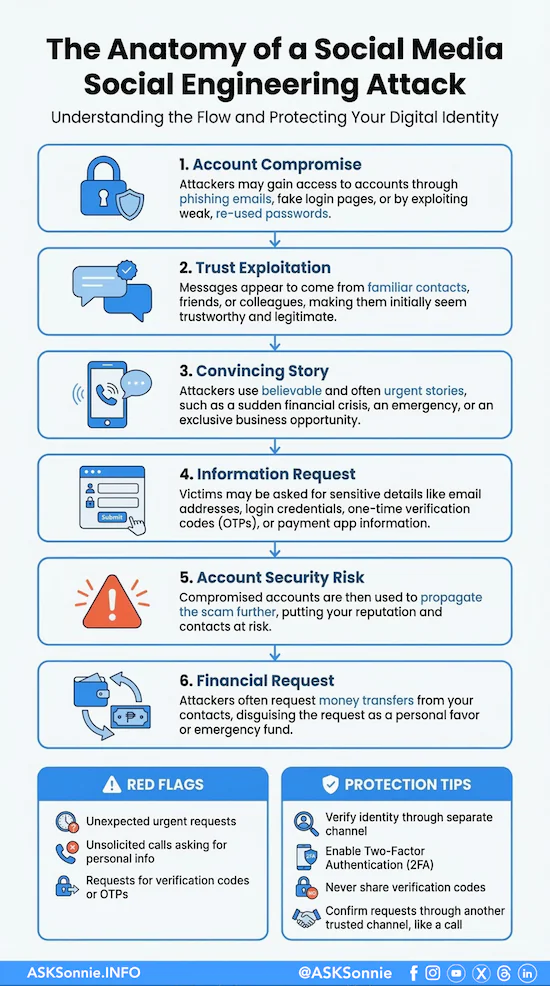
Most scams follow a predictable pattern:
- Account compromise
- Trust exploitation
- Convincing story
- Information request
- Account takeover
- Financial request
Once attackers gain access to one account, they can rapidly spread the scam across the victim’s network.
Warning Signs of a Messenger Scam
Many scams follow recognizable warning signs. Be cautious if someone suddenly:
- asks for money
- requests login codes or personal information
- encourages you to install or open payment apps
- pressures you to act quickly
- asks you to perform unusual actions on your phone
The Meta Security Help Center advises users to be cautious of unexpected messages asking for codes, money, or account access.
How to Protect Yourself From Social Engineering Attacks
Cyber wellness is now a fundamental security skill. Consider these practical steps:
- Verify requests directly. Call the person using another number before responding.
- Enable two-factor authentication (2FA). This significantly reduces account takeover risk.
- Never share verification codes. These codes are meant only for you.
- Be cautious with financial requests. Even if they appear to come from someone you know.
- Secure your email account. Many attackers use email to reset other accounts.
The Federal Trade Commission gave practical advice to avoid social engineering in general and imposter scams in particular.
Why Messenger Scams Are Increasing in the Philippines
In the Philippines, platforms like Facebook, Messenger, GCash, and Maya are widely used for everyday communication and financial transactions.
That convenience also creates opportunities for scammers to exploit trusted relationships online.
Because social networks connect families, workplaces, and communities, a single compromised account can quickly affect many people.
Frequently Asked Questions About Messenger Scams
What is a Messenger scam?
A Messenger scam is a form of social engineering where attackers use compromised Facebook or Messenger accounts to impersonate someone you trust and request money, personal information, or login credentials.
How do hackers take over Messenger accounts?
Most attacks begin when victims unknowingly share login verification codes, respond to fake recovery prompts, or click phishing links that allow attackers to reset passwords and access their accounts.
How can I verify if a Messenger request is legitimate?
Always verify through another channel, such as a direct phone call, SMS, or a different messaging app, before sending money or sharing personal information.
💡 The ASK Takeaway
Cyber wellness begins with responsible digital behavior. This real Messenger scam story shows why the ASK Framework — Align • Strengthen • Kickstart — remains practical in everyday online life.
- Align your habits with the reality that trust can be exploited online.
- Strengthen your defenses through verification, account security, and digital awareness.
- Kickstart safer communities by sharing lessons that help others pause before they click, send, or respond.
Modern scams rarely begin with advanced hacking tools. More often, they begin with a simple message that feels familiar, urgent, and believable.
When a message involves money, account access, verification codes, or urgent action, remember three words: Pause. Verify. Protect.
Discover the full framework →
ASK Framework Cornerstone Page