In the Philippines, the “sandwich generation” refers to adults who find themselves caught between two equally demanding responsibilities: caring for aging parents, and sometimes siblings, while raising and preparing their children for the future. It is a role shaped by culture, economics, and necessity.
Breaking the Sandwich Generation Cycle: Why Your Health is Your Family’s Best Investment
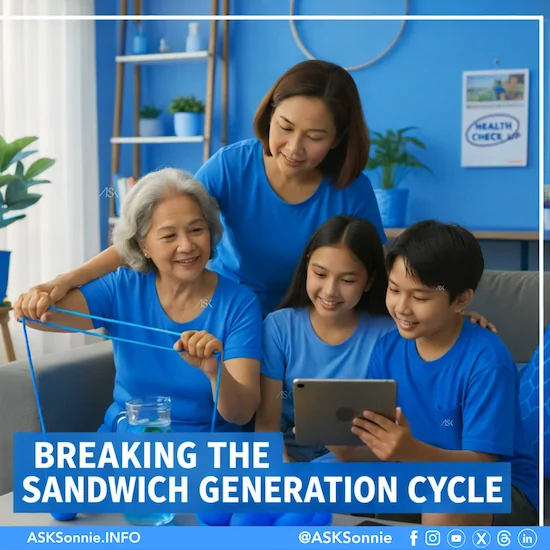
Here, the Sandwich Generation isn’t just a sociological term. It is a daily marathon for millions of Filipino professionals.
We support parents whose healthcare is largely out-of-pocket. We raise children in an increasingly expensive economy. We manage careers while absorbing emotional and financial pressure from both ends.
That’s why some call it a toxic Filipino culture.
@asksonnie Taking care of my health today so my kids won’t have to carry me tomorrow. That’s how I break the sandwich generation. #fyp #sandwichgeneration #fitover50 #parentingtips #familyfirst ♬ original sound Sonnie Santos
It is a delicate balancing act that brings fulfillment, but it can also become unhealthy when boundaries disappear. Helping your family is not the problem; the problem arises when it is no longer guided by wise principles.
💡 Biblical Framework for the Sandwich Generation
These timeless scriptures help us navigate when to give, when to draw the line, and how to balance compassion with accountability:
- Joseph (the dreamer)– *supported his Father and brothers*
“During the time of famine, Joseph provided for his clan” – Genesis 46 -47 (NLT) - Self-Reliance – *huwag umasa*
“Those unwilling to work will not get to eat.” – 2 Thessalonians 3:10 (NLT) - Parental Duty
“Children don’t provide for their parents. Rather, parents provide for their children.” – 2 Corinthians 12:14 (NLT) - Filial Responsibility
“Honor your father and mother…” – Exodus 20:12 (NLT) - When to Help Relatives
1 Timothy 5:3-8 (NLT) teaches care for true dependents, not freeloaders. - Don’t Delay Help
“Do not withhold good from those who deserve it…” – Proverbs 3:27 (NLT)
This is the lived reality of the sandwich generation in the Philippines. It is my reality, and the reality of thousands of Filipinos like me- a demographic pattern documented in studies by the Philippine Institute for Development Studies (PIDS)
Yet, there is a critical factor we often overlook in this equation: Our health is the primary engine that keeps this entire family structure from collapsing.
One Critical Illness Away From Financial Collapse
In a country where out-of-pocket health expenditures remain high, many sandwich generation families are one critical illness away from financial instability.
Despite PhilHealth coverage, benefit limits often fall short of actual hospitalization costs. Data from the
World Bank shows that a significant portion of healthcare spending in the Philippines remains out-of-pocket, increasing the risk of catastrophic health expenditure.
For the sandwich generation, illness is not just a personal issue. It becomes a family-wide financial emergency.
Genetics Is a Risk Profile, Not a Verdict
Many Filipino families have a documented history of stroke, high cholesterol, and cardiovascular disease. According to the Department of Health Philippines and the World Health Organization , cardiovascular disease remains one of the leading causes of death in the country.
Genetics may set the risk, but lifestyle determines the outcome.
For those of us in the sandwich generation, ignoring our health risks does not only endanger us. It destabilizes the very people we are trying to protect.
The Domino Effect on Family Stability
For those in the sandwich generation, a sudden health crisis— whether a stroke, heart attack, or chronic kidney disease—creates ripple effects:
- Financial Depletion: A single ICU stay can wipe out years of savings both of the parents and the children.
- Educational Disruption: When funds are diverted to medical emergencies, children often have to put their education on hold.
- The Burden of Care: Children may become caregivers far too early, limiting their career mobility and long-term growth.
💡 Applying the ASK Framework
The ASK Framework — Align • Strengthen • Kickstart — guides individuals and organizations in translating awareness into responsible action.
- Align: Accept the realities and pressures faced by the sandwich generation and define healthy boundaries rooted in purpose and stewardship.
- Strengthen: Build physical resilience and financial readiness through prevention, fitness habits, and basic protection planning.
- Kickstart: Start with one measurable action this week: check your BP/BS/LDL, commit to daily movement, and schedule a preventive checkup.
When we align purpose, strengthen people, and kickstart progress, we turn principles into lasting impact.
Fitness as an Act of Care, Not Vanity
Many of us carry a genetic inheritance we never asked for. In my case, it includes a family history of hypertension, cardiovascular disease, and a strong likelihood of diabetes.
Fighting Genetics with Grit
Lifestyle plays a decisive role. Regular physical activity improves lipid profiles, insulin sensitivity, and vascular health, as supported by evidence from the American Heart Association and the Harvard T.H. Chan School of Public Health
.
Committing to fitness is not about aesthetics or ego. It is about responsibility.
By committing to a fitness routine in my mid-50s—through Japanese interval walking, running, strength training and disciplined movement— I am intentionally working to stay functional, independent, and present.
Not to extend youth, but to extend usefulness.
Staying Fit to Care for My Wife
When your spouse is older, health timelines compress. Staying fit allows me to remain physically capable and emotionally available to provide care when it is needed.
In this context, fitness becomes an act of marital stewardship rather than personal indulgence.
Avoiding the “Maintenance Trap”
The goal is not to reject medicine, but to delay dependence on it whenever possible.
Lifelong maintenance medications for high blood pressure, blood sugar, and cholesterol carry both financial and quality-of-life costs. Preventive fitness is not anti-medicine; it is pro-timing.
Consistent movement, strength training, and cardiovascular conditioning can delay or reduce the need for maintenance medications for hypertension, diabetes, and high cholesterol. The U.S. Centers for Disease Control and Prevention and the National Institutes of Health emphasize lifestyle intervention as a primary prevention strategy.
In the Philippine setting, where long-term medication is often paid out-of-pocket, prevention is not idealistic. It is practical.
Defining Success for the Sandwich Generation
Success for the sandwich generation is no longer defined by endless hustle or heroic exhaustion. It is defined by sustained strength, mental clarity, and the ability to age without becoming a crisis.
The World Health Organization’s Healthy Ageing framework emphasizes functional ability, independence, and dignity as core outcomes of healthy aging.
Prioritize the “Big Three”
Regular screenings for blood pressure, blood sugar, and LDL cholesterol are non-negotiable.
Knowing your numbers is the first step in preventative health management.
Movement as Medicine
You don’t need an elite gym.
Brisk walking—specifically the Japanese “Manpo-kei” philosophy—coupled with resistance training, can significantly improve your VO2Max and overall fitness, a key indicator of longevity.
Nutrition Over Maintenance
Focus on a “Philippines-friendly” anti-inflammatory diet.
Prioritizing local produce and lean proteins over processed carbohydrates can help manage cholesterol naturally before you ever need to reach for a prescription pad.
The Legacy of the Sandwich Parents: Protecting their Children from Inheriting the Sandwich
In Filipino culture, legacy is often measured in property, education, and reputation. Yet one of the most meaningful legacies a sandwich generation parent can leave is the legacy of not becoming a burden. Many sandwich parents quietly share the same goal: they do not want their children to inherit the same cycle of pressure and obligation.
We often think of legacy as something we leave behind.
However, the most selfless gift a sandwich generation parent can give is their own health.
Staying healthy reduces the likelihood of long-term caregiving dependence, preserves savings for more value adding purposes, and gives children the emotional and financial freedom to build forward rather than merely sustain backward.
Breaking the Cycle for the Next Generation
- Sparing the Stress: By staying fit, you remove the emotional and physical burden of caregiving from your children..
- Break free from vices and unhealthy lifestyles before their consequences become your children’s responsibility.
- Protecting Their Future Savings: You ensure their hard-earned money stays in their accounts, allowing them to invest in their own homes and dreams.
- Modeling Healthy Aging: You show your children that aging can be a season of strength and contribution, not decline.
- Secure insurance, as much as possible, to cover your health needs as you enter your senior years.
Frequently Asked Questions
What is the sandwich generation in the Philippines?
In the Philippines, the sandwich generation refers to adults who support aging parents (and sometimes siblings) while also raising and providing for their children. The pressure often includes caregiving, education costs, and out-of-pocket healthcare expenses.
Why is health so important for the sandwich generation?
Because illness doesn’t stay “personal” in a sandwich household. A health crisis can drain savings, disrupt children’s education, and create long-term caregiving dependency. Prevention protects both your body and your family’s financial stability.
How can I start breaking the sandwich generation cycle?
Start with one measurable step: know your BP, blood sugar, and LDL; commit to daily movement; and schedule a preventive checkup. Small weekly actions reduce crisis risk and build long-term resilience.
Do I need an expensive gym or program to get healthier?
No. Brisk walking, interval walking, and basic strength training can meaningfully improve cardiovascular health and functional strength. Consistency matters more than complexity.
What does “success” look like for the sandwich generation?
Success is not heroic exhaustion. It’s sustained strength, mental clarity, and the ability to age with dignity and independence so your children are not forced into early caregiving or financial rescue.
Is it wrong to help family members financially?
Helping family is not wrong, but it becomes unhealthy when it removes accountability or destroys boundaries. A wise approach combines compassion with clear limits, especially when support becomes enabling.
“Grinding not to add years to life, but to add life to years!”
Your health is the foundation of your family’s stability. By taking care of yourself today, you aren’t just living longer—you are ensuring your family thrives for generations to come.
💡 The ASK Takeaway
Breaking the sandwich generation cycle aligns perfectly with our ASK Framework — Align • Strengthen • Kickstart:
- Align your priorities with stewardship, boundaries, and long-term family stability.
- Strengthen your health and resilience through prevention, movement, and disciplined habits.
- Kickstart small weekly actions that reduce crisis risk and protect the next generation.
Discover the full framework →
ASK Framework Cornerstone Page