A simple, plain-language explainer of what “due process in the workplace” means in Philippine context — for both employees and employers — including how to handle terminations, resignations, and separations fairly.
How To’s of Due Process in the Workplace
Last legally reviewed: December 2025. This guide is written by an experienced HR practitioner and people strategist, referencing the Philippine Labor Code, DOLE rules, and updated jurisprudence. It is for general information only and should not be taken as legal advice.
When employee rights and management prerogatives collide, the workplace can quickly become toxic and litigious. The mechanism that balances both sides is what the law calls due process. Non-observance of this can result in mistrust, embarrassment, and monetary damage to both the company and the employee.
In Philippine workplaces, due process is meant to protect security of tenure on one hand, and the employer’s right to discipline and manage the business on the other (see Labor Code, Article 294 on security of tenure and Article 297 on termination by employer).
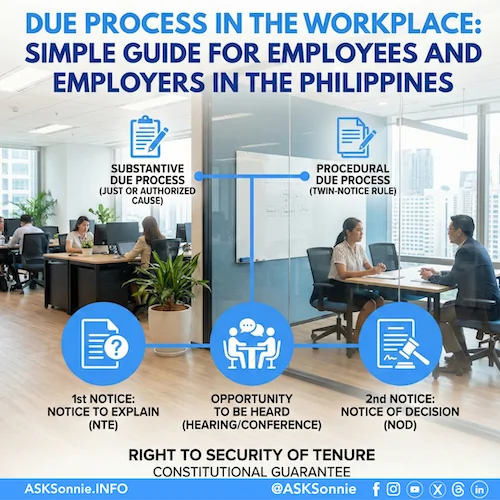
What due process in the workplace means in the Philippines
In simple terms, due process is a fair way of making decisions that affect a person’s job. It answers two basic questions:
- Is there a valid reason? (the “what” – this is substantive due process)
- Was the proper procedure followed? (the “how” – this is procedural due process)
Under the Labor Code, a regular employee can only be terminated for just causes (usually related to employee fault) or authorized causes (usually related to business conditions or health) as provided in Article 294, Article 297, Article 298, and Article 299 of the Labor Code.
Substantive vs. procedural due process
Substantive due process is about the lawful ground for termination or disciplinary action:
- Just causes – serious misconduct, willful disobedience, gross and habitual neglect, fraud or breach of trust, crime against the employer or family, and analogous causes (see Labor Code, Article 297 on termination by employer).
- Authorized causes – installation of labor-saving devices, redundancy, retrenchment to prevent losses, or closure/cessation of business not intended to circumvent the law, as outlined in Article 298 of the Labor Code.
- Disease – when continued employment is prohibited by law or prejudicial to health, subject to medical certification and separation pay under Article 299 of the Labor Code.
Procedural due process is about the steps that must be followed. For just causes, this usually involves the twin notice rule and an opportunity to be heard. For authorized causes, it involves prior written notices to employees and to DOLE, plus the proper separation pay where applicable (see this twin notice rule explainer and Article 298 of the Labor Code).
Decision Flow — Before You Terminate
- What is the main reason?
Misconduct, performance, or policy violations → treat as a just cause case.
Redundancy, retrenchment, closure, labor-saving devices → treat as an authorized cause case.
Serious illness affecting work or co-workers → treat as disease under Article 299. - Is the ground properly documented?
Incident reports, NTEs, performance records, financial statements, business plans, medical findings, etc. - Have you followed the correct process?
- Just cause: Notice to Explain → opportunity to be heard / admin meeting → Notice of Decision.
- Authorized cause: 30-day written notice to employees and DOLE → correct separation pay.
- Disease: Certification from a competent public health authority → separation pay if termination proceeds.
- Have you checked legal and people risks?
If unsure, pause and consult HR, DOLE guidance, or legal counsel before implementing the decision.
Just causes: when termination can be immediate
Some acts are so grave that they can justify outright termination (after due process), even without a long trail of prior sanctions. These are the just causes recognized in Labor Code, Article 297.
- Serious misconduct – wrongful acts that are willful, work-related, and of such gravity that continued employment becomes impossible (e.g., grave sexual harassment, violent behavior at work).
- Willful disobedience – deliberate refusal to follow lawful and reasonable work-related orders of the employer or representative.
- Gross and habitual neglect of duties – repeated failure to perform duties with the care expected, resulting in loss or risk to life, property, or operations (e.g., repeated failure to follow safety procedures leading to accidents or serious near-misses).
- Fraud or willful breach of trust – acts of dishonesty or abuse of confidence (e.g., theft, falsification, mishandling of confidential information) especially for positions of trust such as cashiers, tellers, warehouse and HR personnel, supervisors, and managers.
- Commission of a crime or offense – when the act is committed against the employer, any immediate family member, or duly authorized representative (e.g., qualified theft, physical assault).
- Analogous causes – other voluntary acts or omissions similar in nature and gravity to the above, such as gross immoral conduct clearly impacting the workplace.
The gravity of the result often guides decisions. For example, failing to switch off a light may warrant a warning, but failing to turn off gas equipment that leads to fire and major loss can point to gross negligence. In all cases, no disciplinary action or termination should be implemented without due process.
For terminations involving probationary employees, the due process steps remain crucial. You can read more here: Ending Probationary Employment Without a Termination Notice.
Procedural due process for just-cause cases
For terminations based on just causes, the standard approach is the twin notice rule plus a real opportunity for the employee to explain his or her side (see this overview of employee due process in the Philippines).
- Notice to Explain (NTE) – a written memo stating:
- What happened (facts and alleged violations)
- Which company policy or legal ground may have been violated
- How much time the employee has to submit a written explanation (reasonable period)
You can check a sample framework here: How to write a Notice to Explain.
- Opportunity to be heard – this can be:
- A written explanation from the employee, and/or
- An administrative meeting or hearing where both sides can present facts and clarifications.
An admin hearing is not always mandatory, but it is highly recommended for termination cases to reduce risk for both sides (see again the twin notice rule explainer for context).
- Notice of Decision (NOD) – a written memo stating:
- The findings of the investigation
- The legal and policy basis
- The penalty, if any (e.g., warning, suspension, termination)
For reference, see: How to write a Notice of Decision.
These steps are not just legal formalities. They help decision-makers avoid bias, ensure documentation, and give employees the dignity of being heard before a final decision is made.
Authorized causes: redundancy, retrenchment, closure
Sometimes, employees lose their jobs not because of any fault, but because the business needs to adjust or shut down. These are authorized causes under Article 298 of the Labor Code.
- Installation of labor-saving devices – when new technology or systems make certain positions unnecessary.
- Redundancy – when a position becomes superfluous due to reorganization, drop in volume, or other efficiency measures.
- Retrenchment to prevent losses – when the company reduces personnel to prevent or minimize serious financial losses.
- Closure or cessation of operations – when the establishment stops operations, whether due to losses or business decisions (e.g., relocation, change of market).
Employers in these situations still have to observe due process and separation pay rules:
- 30-day prior written notice to the affected employees and to DOLE before the intended date of termination, as required under Article 298.
- Separation pay, as a general rule:
- For labor-saving devices or redundancy – at least one month pay or one month pay for every year of service, whichever is higher.
- For retrenchment to prevent losses and closures not due to serious business losses – one month pay or at least one-half month pay for every year of service, whichever is higher (a fraction of at least six months is considered one year).
These minimum standards are also found in Article 298 of the Labor Code.
Losses are not always required to close a business; owners may lawfully shut down or relocate for strategic reasons, but must respect notice and separation pay rules where applicable.
Termination for health reasons
Termination due to disease is technically an authorized cause but is treated with special safeguards because of its impact on dignity, health, and livelihood. The conditions are outlined in Article 299 of the Labor Code.
An employee may be terminated for health reasons only when:
- The employee suffers from a disease where continued employment is prohibited by law or is prejudicial to the employee’s health or that of co-workers.
- A competent public health authority (not just the company doctor) certifies that the disease is of such nature or at such a stage that it cannot be cured within six months even with proper medical treatment, as required under IRR, Rule I, Section 8.
- The employee is paid separation pay equivalent to at least one month salary or one-half month salary for every year of service, whichever is greater (a fraction of at least six months is considered one whole year), consistent with Article 299 of the Labor Code.
If the disease can be cured within six months, the rule is no termination yet; the employee should instead be placed on leave of absence and reinstated upon medical clearance.
What happens when due process is not followed?
The consequences of skipping due process depend on whether the problem is with the ground (substantive due process), the procedure (procedural due process, or both.
- No valid ground + defective procedure – the dismissal can be declared illegal. Usual remedies include reinstatement without loss of seniority rights and full backwages, in line with the security of tenure guarantee under Article 294 of the Labor Code.
- Valid ground + defective procedure – Supreme Court doctrine generally upholds the dismissal but awards nominal damages for violation of procedural due process (Wenphil/Agabon line of cases).
- Suspension without basis or without proper process – can lead to a finding of “illegal suspension” and payment of lost wages for the period of the unlawful suspension.
Over the years, Supreme Court rulings like Wenphil, Serrano, and Agabon have tried to balance preventing “terminate now, pay later” abuse by employers and avoiding unjust enrichment of employees through litigation.
If separation becomes final—whether due to resignation, termination for cause, or authorized cause—employees should also know their entitlements. Read: Final Pay in 30 Days, COE in 3 Days.
Due process in the workplace is a two-way street
Due process in the workplace is often discussed in the context of management disciplining employees, but it also applies when employees themselves decide to end the relationship.
- For employers – observe due process whenever a decision directly affects employment, including:
- Preventive suspension, coaching, and other disciplinary measures
- Progressive discipline in the workplace
- Just-cause terminations (misconduct, neglect, fraud, etc.)
- Authorized-cause terminations (redundancy, retrenchment, closure)
- Termination for health reasons
These actions should be anchored on the Labor Code and relevant company policies.
Related reading for HR: when is extending a probationary period legal and defensible? See: Probationary Period Extension in the Philippines.
- For employees – due process also applies when they terminate the relationship from their side. As a general rule, an employee who resigns without just cause is required to give at least 30 days written notice to the employer, in line with Article 300 of the Labor Code on termination by employee. You can read more here: Due process when resigning.
When both sides observe due process, it becomes easier to sustain industrial peace and build a values-based, rights-respecting workplace.
Practical tips for HR, managers and employees
- Document everything. Keep copies of notices, explanations, minutes of administrative meetings, and evidence. Good documentation protects both the company and the employee.
- Use clear, neutral language in memos. Avoid personal attacks; focus on facts, dates, and specific policy provisions.
- Train supervisors on due process and termination grounds. Frontline leaders should know the difference between just and authorized causes, when progressive discipline is appropriate, and when immediate action is justified.
- Ask questions if you are unsure. Employees can respectfully ask HR or their manager to clarify the basis of a memo or the steps in an investigation.
- Seek professional advice for complex cases. For high-risk terminations, complaints, or large-scale retrenchments, it is wise for both employers and employees to consult a lawyer or experienced HR practitioner.
FAQs on Due Process in the Workplace (Philippines)
1. Is an administrative hearing always required before termination?
No. The law requires that the employee be given a real opportunity to be heard, which may be through a written explanation and/or a meeting. However, for termination cases, especially high-risk ones, an administrative meeting or hearing is strongly recommended to reduce the risk of later disputes.
2. Can an employee be terminated immediately for gross misconduct?
In practice, even “immediate” terminations for grave misconduct must still observe procedural due process (Notice to Explain, opportunity to be heard, and Notice of Decision). The gravity of the offense may justify termination without progressive discipline, but it does not remove the need for due process.
3. What if an employee refuses to receive or sign the Notice to Explain?
If an employee refuses to receive or sign the NTE, the employer may have the refusal witnessed (e.g., by two witnesses) and document it in writing. The NTE may also be sent via registered mail or other documented channels. The key is that the employer can prove that a meaningful opportunity to explain was given.
4. Does due process apply to probationary employees and those on fixed-term contracts?
Yes. Due process applies to all employees, including probationary and fixed-term workers. For probationary employees, the employer must also show that reasonable standards were communicated at the start and that the employee failed to meet them.
💡 The ASK Takeaway
Due process in the workplace aligns perfectly with our ASK Framework — Align • Strengthen • Kickstart:
- Align your policies and decisions with lawful, values-based due process — not personal bias or convenience.
- Strengthen capacity through clear standards, documentation, and fair hearings that protect both people and the business.
- Kickstart culture shifts where discipline, separation, and resignation are handled with respect, clarity, and empathy.
Discover the full framework →
ASK Framework Cornerstone Page

 wpDiscuz